
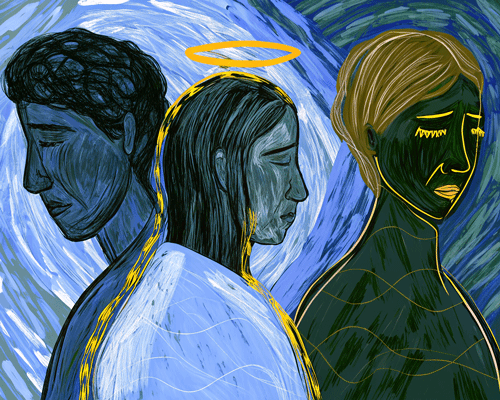
Dysfunctional family roles are the parts children take on to keep a stressed family running. The five most common are the golden child, the scapegoat, the lost child, the mascot and the caretaker. Each one helps a child get through what's happening at home. Most people carry theirs into adulthood without noticing, until it starts shaping their relationships, their work and how they see themselves.
If you recognized yourself in one of those names, keep reading. Seeing your role clearly is where change starts.
Why families hand out roles
When a family is organized around a problem, everyone adapts. The problem might be addiction, a parent's untreated mental illness, constant conflict or a parent who can't manage their own emotions.
Nobody sits down and assigns parts. Children read what the family needs and become it. One keeps the peace. One takes the blame. One disappears.
These roles aren't personality. They're strategy. Family therapists first described them while working with families affected by addiction, and the pattern shows up in many kinds of family stress.
The golden child
The golden child makes the family look okay. Good grades, good behavior, the one the adults point to when they need proof that things are fine. Some therapists call this role the hero.
It looks like the lucky role. It isn't. Love that depends on performance never feels safe.
In adulthood it often shows up as:
Perfectionism and a sense that your worth depends on what you achieve
Trouble resting or asking for help
Anxiety when you fall short, even a little
Quiet guilt about how your siblings were treated
The scapegoat
The scapegoat gets blamed for the family's problems. They're often the child who reacts honestly to what's wrong, and the family labels that honesty as trouble.
In adulthood it often shows up as:
Shame and a habit of expecting blame
Anxiety, depression or a harsh inner critic
A strong sense of fairness and a low tolerance for denial
Scapegoats are often the first in the family to seek therapy. They're also more likely to step back to low contact or no contact, because they've seen the pattern most clearly.
The lost child
The lost child copes by disappearing. They need little, ask for nothing and stay out of the way while the family's attention goes elsewhere.
In adulthood it often shows up as:
Trouble knowing or naming what you want
Feeling invisible in groups and relationships
Avoiding conflict at almost any cost
Loneliness, even around people
The mascot
The mascot breaks the tension. When things get heavy, they make everyone laugh. Humor becomes their job.
In adulthood it often shows up as:
Deflecting with jokes when things get serious
Struggling to be taken seriously, or to take your own pain seriously
Exhaustion from keeping everyone else's mood up
The caretaker
The caretaker grows up too fast. They look after younger siblings, manage a parent's moods or cover for a parent who can't function. Therapists call this parentification.
In adulthood it often shows up as:
Over-responsibility for other people's feelings
People-pleasing and trouble saying no
Burnout, often in helping professions
Discomfort receiving care
How the roles follow you into adulthood
Roles come back wherever there's stress or a group that feels like family. At work. With a partner. At the holiday table.
You can be 40, successful and steady, and still feel twelve the moment you walk into your parents' kitchen. That's the role taking over. It's also why so many adults keep having the same fight with a parent without knowing why.
Roles can also shift. When one sibling leaves home, another often steps into the open part. And many people carry more than one.
Can you change your role?
Yes. The role helped you survive. It doesn't have to run your life now.
Change usually starts small:
Name the role's job. What did it protect you from as a kid?
Notice what it costs you now. Where does it still decide for you?
Try one small move outside it. Ask for help. Skip the joke. Let someone else fix it.
Expect pushback. Families resist change. Clear boundaries help you hold steady when they do.
Therapy gives you a place to do this work with support. Talking helps you see the pattern. When the role is tied to painful memories, EMDR can help those memories lose their grip, so the old reactions stop firing on their own. Learn more about therapy for dysfunctional family patterns.
Frequently asked questions
What are the roles in a dysfunctional family?
The five most common are the golden child (or hero), the scapegoat, the lost child, the mascot and the caretaker. Each is a way a child adapts to a family under stress.
Can you have more than one family role?
Yes. Many people carry two roles, or move between them at different ages. It's common in small families and when a sibling leaves home.
Do family roles change when a sibling leaves home?
Often. The family still needs the job done, so another child steps into it. A quiet child can become the new scapegoat, or the new caretaker.
Is the golden child hurt by their role too?
Yes. The golden child learns that love depends on performance. That often leads to perfectionism, anxiety and trouble feeling worthy without achievement.
Can therapy help with family roles?
Yes. Therapy helps you see your role clearly, understand what it protected you from and practice new ways of responding. EMDR can help when the role is tied to painful memories.
You don't have to keep playing the part
The role you learned made sense once. You get to decide what fits now.
I offer online therapy for adults in Missouri and Kansas, with weekday appointments until 6 PM. Start with a free 15-minute consultation. No pressure, just a conversation about what you're carrying and whether I can help.